

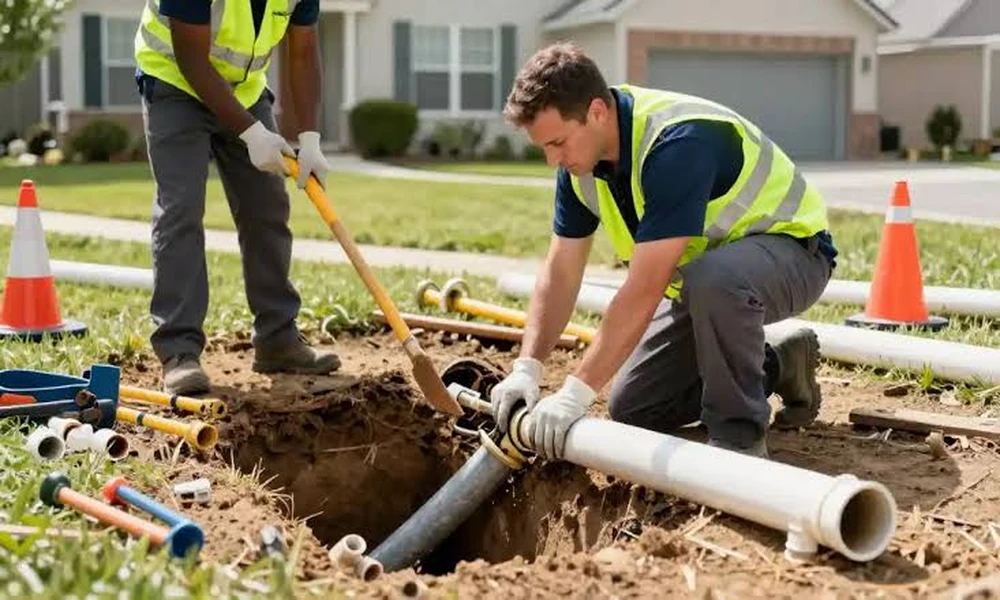
A damaged sewer line can leave homeowners facing a difficult decision: should the affected pipe be repaired, or is it time to replace it entirely?
The answer is not always straightforward. A sewer line that experiences frequent blockages may only need a targeted repair, while another pipe that appears to function reasonably well could have extensive deterioration beneath the surface. Because most sewer lines are buried underground, determining the appropriate solution requires more than observing how quickly water drains from a sink or toilet.
Sewer line repair and replacement serve different purposes. Repairing a damaged section can preserve much of the existing plumbing infrastructure, while replacement addresses problems that extend beyond what localized repairs can reasonably correct.
The challenge is understanding when each approach makes sense.
Pipe material, age, structural condition, previous repairs, and the extent of damage all influence the decision. Modern inspection technology also allows plumbers to evaluate underground pipes more accurately, helping homeowners understand their options before committing to extensive work.
Knowing how these factors fit together can make sewer line decisions less confusing and help homeowners distinguish between a manageable plumbing repair and a more significant infrastructure problem.
Understanding the Difference Between Sewer Line Repair and Replacement
Although the terms are sometimes used interchangeably, sewer line repair and sewer line replacement describe different approaches to restoring a property’s wastewater drainage system.
Both aim to restore proper wastewater flow, but the amount of existing piping that remains in place can differ considerably.
What Is Sewer Line Repair?
Sewer line repair focuses on correcting a specific problem while preserving sections of the existing pipe that remain functional and structurally sound.
Depending on the condition of the line, repairs may involve removing and replacing a short damaged section, correcting a separated joint, or rehabilitating an existing pipe using an appropriate lining method.
For example, imagine a homeowner discovers that tree roots have entered through a damaged joint in an otherwise serviceable sewer line.
If the surrounding pipe remains in good condition, repairing the affected section may resolve the structural problem without requiring replacement of the entire line.
The suitability of this approach depends on whether the remaining pipe can continue functioning reliably.
Repairing one section of a sewer line does not automatically correct deterioration elsewhere in the system.
What Is Sewer Line Replacement?
Sewer line replacement involves removing, abandoning, or otherwise replacing an existing section of sewer piping with a new pipe.
Replacement may involve a short section, a substantial portion of the line, or the entire private sewer connection, depending on the damage.
For instance, an older sewer line with extensive corrosion, multiple fractures, and repeated structural failures may no longer be a suitable candidate for isolated repairs.
Replacing the deteriorated piping can address problems affecting the line as a whole rather than repeatedly correcting individual defects.
The fundamental difference is that sewer line repair preserves usable existing piping, while replacement introduces new piping where the original line can no longer provide dependable service.
Neither option is automatically better. The appropriate solution depends on what is happening inside the pipe.
Why the Condition of the Pipe Matters More Than Its Age
One of the first questions homeowners ask about an aging sewer line is whether it has reached the end of its useful life.
Age provides useful context, but it does not tell the complete story.
Two homes built during the same decade may have sewer lines in very different conditions.
One property may have well-supported piping with minimal deterioration, while another may have experienced soil movement, root intrusion, corrosion, or repeated blockages.
Older Pipes Are Not Automatically Beyond Repair
Many older properties contain sewer lines made from cast iron, vitrified clay, concrete, or other materials that were commonly installed during earlier construction periods.
These materials have different characteristics and vulnerabilities.
Cast iron pipes can experience corrosion and internal scaling. Clay pipes resist many forms of chemical deterioration but may crack or develop joint problems. Concrete piping can deteriorate under certain chemical and environmental conditions.
However, the presence of an older material does not necessarily mean replacement is required.
A clay sewer line with one damaged joint may still be a reasonable candidate for targeted repair if the remaining sections are sound.
Likewise, an older cast iron line with limited deterioration may not need complete replacement simply because of its installation date.
Newer Pipes Can Develop Problems Too
Modern sewer systems commonly use plastic piping materials such as PVC, which resist many forms of corrosion.
However, newer materials are not immune to damage.
Improper installation, inadequate bedding, soil movement, construction activity, or excessive external loads can contribute to structural problems.
A relatively new pipe may develop an offset joint or fracture that requires repair.
This is why the actual condition of the pipe is more important than making decisions based solely on age or material.
When Sewer Line Repair Is Usually the More Practical Option
Sewer line repair is often considered when the damage is limited, accessible, and surrounded by piping that remains structurally sound.
The goal is to correct the identified defect without replacing sections that continue to perform properly.
Localized Cracks or Fractures
A sewer line may develop a crack in one section while the rest of the pipe remains intact.
If the defect is isolated and the surrounding pipe has adequate structural integrity, a localized repair may be appropriate.
Depending on the circumstances, this could involve excavating the damaged section and installing replacement piping.
In suitable cases, certain trenchless rehabilitation methods may also be considered.
The decision depends on the size and location of the fracture, pipe alignment, material, and access conditions.
A Single Damaged or Separated Joint
Sewer pipes are often assembled from individual sections connected by joints.
Over time, ground movement or deterioration can cause a joint to shift, separate, or lose its seal.
This can create an opening where roots enter or wastewater escapes.
When the damage is confined to one joint, correcting that connection may be sufficient.
However, if multiple joints have separated because of widespread soil movement or deteriorating pipe conditions, a broader solution may be necessary.
Limited Tree Root Damage
Tree roots are a common source of sewer line problems, particularly where older pipes have cracks or openings at their joints.
Roots can grow into these openings and create obstructions that interfere with wastewater flow.
Removing the roots may restore drainage temporarily, but it does not necessarily correct the opening that allowed them to enter.
If the pipe remains structurally sound except for a limited defect, targeted sewer line repair may help prevent recurring intrusion.
When roots have entered through numerous damaged joints or the pipe has become severely fractured, replacement may be more appropriate.
A Repairable Section Within an Otherwise Healthy Line
Consider a property with a sewer line that is generally in good condition but has one damaged section beneath an accessible part of the yard.
If an inspection confirms that the remaining piping is structurally sound, replacing only the affected section may be a reasonable approach.
This avoids disturbing usable infrastructure unnecessarily.
However, the decision should account for the likelihood of future problems in the sections that remain.
A repair that solves today’s defect but leaves widespread deterioration unaddressed may provide only limited long-term benefit.
When Sewer Line Replacement May Be the Better Decision
Replacement becomes more relevant when damage affects a substantial portion of the sewer line or when the remaining pipe cannot reliably support continued use.
The decision is not necessarily based on how severe one visible symptom appears.
A pipe can have extensive structural deterioration without producing dramatic drainage problems every day.
Widespread Corrosion or Deterioration
Corrosion can gradually weaken certain pipe materials, particularly older metallic sewer lines.
As deterioration progresses, pipe walls may become thinner, rougher, or structurally compromised.
A localized repair may not be sufficient if similar damage exists throughout the line.
For example, replacing one severely corroded section may restore drainage temporarily, but adjacent sections with comparable deterioration could develop problems later.
When the damage is widespread, replacement may provide a more comprehensive solution.
Multiple Cracks or Structural Defects
A sewer line containing several fractures, displaced joints, or deteriorated sections presents a different situation from a pipe with one isolated defect.
Repairing each problem individually may be technically possible in some cases.
However, the cumulative condition of the line matters.
If numerous sections are already compromised, replacing the affected length may be more practical than performing repeated localized repairs.
Collapsed or Severely Deformed Pipes
A collapsed sewer line has lost part or all of its original structural shape.
This can restrict or prevent wastewater flow and may make certain rehabilitation techniques unsuitable.
Severe deformation can also prevent equipment from passing through the pipe.
Depending on the extent of the collapse and surrounding conditions, excavation or pipe replacement may be necessary.
Not every collapsed section requires replacement of the entire sewer line, but the damaged portion generally needs more than routine drain cleaning.
Repeated Failures in Different Sections
A history of sewer line problems can provide useful information about the system’s overall condition.
Imagine a homeowner who has already repaired one section of an aging sewer line.
A year later, a different section develops a crack. Another repair follows, but additional deterioration appears elsewhere.
Although each defect may be individually repairable, the pattern raises questions about the remaining pipe’s reliability.
Repeated failures in separate locations can indicate that the problem extends beyond isolated damage.
In these circumstances, replacement may become a more reasonable long-term option.
How Plumbers Evaluate Whether to Repair or Replace a Sewer Line
Choosing between sewer line repair and replacement requires understanding the pipe’s actual condition.
Because underground sewer lines are difficult to inspect directly, plumbers often combine drainage observations, maintenance history, and specialized diagnostic equipment.
Sewer Camera Inspections
Modern sewer camera equipment allows plumbers to examine accessible sections of underground drainage piping.
A camera is inserted into the sewer line, providing visual information about the pipe’s interior.
An inspection may reveal:
- Cracks, fractures, or separated joints
- Root intrusion and accumulated debris
- Corrosion or deterioration
- Pipe deformation or collapse
- Misaligned sections
- Areas of standing water or restricted flow
This information helps distinguish between problems that may respond to cleaning and those involving structural defects.
However, camera inspections have limitations.
Heavy debris or standing water can obscure portions of the pipe, and a camera cannot always determine the condition of surrounding soil or the remaining thickness of a deteriorated pipe wall.
Additional investigation may be needed when the available evidence is inconclusive.
Evaluating the Extent of Damage
A single crack and widespread pipe deterioration may produce similar drainage symptoms.
The difference becomes clearer when the full accessible length of the line is evaluated.
Plumbers consider whether defects are isolated, concentrated within one section, or distributed throughout the system.
They also assess whether undamaged sections have sufficient structural integrity to remain in service.
According to experienced plumbers in Miami, the extent and distribution of damage are important considerations because a repair should address the underlying defect without overlooking deterioration that could compromise the remaining line.
Considering the History of the Sewer System
Past plumbing problems can influence the decision.
A sewer line that has functioned reliably for many years before developing one isolated defect presents a different situation from a line with repeated backups and repairs.
Relevant history may include previous pipe replacements, recurring root intrusion, repeated drain cleaning, known soil movement, or documented structural defects.
This information helps determine whether the current problem is an isolated event or part of a larger pattern.
Traditional Excavation vs. Trenchless Sewer Line Methods
Another important consideration is how the work will be performed.
Homeowners sometimes assume sewer line repair always involves digging a long trench through the yard.
Although excavation remains necessary in many situations, modern plumbing technology offers additional methods for certain pipe conditions.
Traditional Excavation
Traditional sewer line work involves exposing the affected pipe through excavation.
This provides direct access to damaged sections and allows plumbers to remove and replace piping as needed.
Excavation may be necessary when a pipe has collapsed, when alignment must be corrected, or when conditions prevent the use of trenchless methods.
It also allows surrounding soil and pipe connections to be evaluated directly.
The extent of excavation depends on the pipe’s location, depth, accessibility, and the length requiring repair or replacement.
Cured-in-Place Pipe Lining
Cured-in-place pipe lining, commonly called CIPP, is a rehabilitation method that creates a new lining within an existing pipe.
When conditions are suitable, the process can address certain defects without excavating the entire pipe route.
The existing pipe must generally provide an appropriate pathway for installation, and the method must be compatible with the pipe’s condition and geometry.
Significant collapse, severe deformation, or other structural problems may prevent its use.
Although pipe lining can rehabilitate an existing sewer line, it is not appropriate for every type of damage.
Pipe Bursting
Pipe bursting is a replacement method that breaks apart the existing pipe while drawing a new pipe into position.
It can reduce the need for continuous trench excavation, although access pits and other excavation may still be required.
The method depends on factors such as existing pipe material, alignment, nearby utilities, available access, and site conditions.
Pipe bursting is a form of replacement rather than a localized repair because new piping takes the place of the existing line.
Why Trenchless Does Not Always Mean Better
Trenchless methods can reduce disruption to certain landscaping and paved surfaces.
However, the least disruptive method is not automatically the most appropriate one.
A severely misaligned pipe may require correction that cannot be achieved through lining.
Likewise, certain site conditions may make conventional excavation more practical or technically suitable.
The best method is the one that addresses the actual pipe problem while meeting applicable installation and structural requirements.
Five Factors That Influence the Repair-or-Replacement Decision
Beyond identifying the visible defect, plumbers consider several practical factors before recommending an approach.
1. Structural Integrity of the Remaining Pipe
The condition of the pipe surrounding the damaged section is one of the most important considerations.
If the remaining line is sound, localized repair may preserve useful infrastructure.
If widespread deterioration exists, replacement may provide a more complete solution.
2. Location and Accessibility
A damaged sewer section beneath an open lawn presents different access challenges from one beneath a driveway, building foundation, or established landscaping.
Access conditions can influence the available repair methods and the extent of surface disruption.
However, accessibility should not override structural requirements.
A convenient repair is only useful if it adequately addresses the underlying damage.
3. Severity and Distribution of Damage
A single separated joint, multiple fractures, and complete pipe collapse represent different levels of structural concern.
The number, location, and severity of defects help determine whether a targeted repair is sufficient.
4. Previous Repairs and Recurring Problems
A history of repeated sewer line failures may suggest that the system is experiencing broader deterioration.
Plumbers may consider whether previous repairs corrected isolated problems or whether new defects continue appearing in different sections.
5. Long-Term Reliability
The immediate objective is to restore proper drainage, but the expected durability of the solution also matters.
A localized repair may be entirely appropriate when the remaining pipe is healthy.
In contrast, repeated repairs to a severely deteriorated line may leave the homeowner facing ongoing interruptions.
Evaluating long-term reliability helps ensure that the chosen approach matches the condition of the plumbing system.
Why a Sewer Line Backup Does Not Automatically Mean Replacement
One misconception is that a major wastewater backup means the sewer line must be replaced.
Although backups can indicate serious problems, they do not establish the structural condition of the pipe.
A substantial obstruction can occur inside an otherwise intact sewer line.
Grease accumulation, inappropriate materials, or other debris may restrict wastewater flow without causing structural damage.
In such cases, appropriate drain cleaning may restore normal operation.
However, the opposite can also be true.
A damaged sewer line may continue draining for some time despite significant structural defects.
This is why drainage symptoms alone should not determine whether repair or replacement is necessary.
The underlying cause matters more than the inconvenience of the symptom.
What Happens When Only Part of a Sewer Line Is Replaced?
Partial sewer line replacement can be a practical option when damage affects a defined section but the surrounding piping remains serviceable.
For example, a homeowner may have a sewer line that contains one collapsed section near the property’s exterior.
If the remaining sections are structurally sound, replacing the collapsed portion may restore the line without requiring complete replacement.
However, transitions between old and new piping require careful consideration.
Connecting Different Pipe Materials
Older sewer systems may contain materials that differ from modern replacement piping.
When connecting new piping to an existing line, appropriate fittings and compatible connections are necessary.
The connection must maintain proper alignment, sealing, and structural support.
Improper transitions can create future problems, including leakage, root intrusion, or debris accumulation.
Maintaining Proper Pipe Slope
Gravity-driven sewer systems rely on appropriate pipe slope to transport wastewater.
A replacement section must be installed with suitable alignment and grade.
Insufficient slope can contribute to poor drainage and sediment accumulation, while an improperly designed or installed transition can interfere with wastewater flow.
Applicable plumbing codes and site conditions influence installation requirements.
Evaluating the Sections That Remain
Partial replacement should not focus exclusively on the visibly damaged area.
The condition of adjacent piping matters because deterioration near the repair could affect long-term performance.
This is particularly relevant in older systems where multiple sections may have experienced similar environmental conditions.
How Sewer Line Decisions Affect Long-Term Plumbing Maintenance
Repair and replacement can both restore wastewater drainage, but they may create different maintenance considerations.
A repaired sewer line retains some or most of its original piping.
As a result, the condition of those remaining sections continues to influence future maintenance needs.
A replaced section introduces new piping, but it does not eliminate the possibility of blockages, improper disposal, ground movement, or problems elsewhere in the system.
Repairing a Pipe Does Not Make the Entire System New
A successful localized repair addresses the identified defect.
It does not necessarily improve the condition of unaffected sections.
For example, repairing a cracked joint in an older clay sewer line does not prevent other joints from developing problems in the future.
That does not make the repair ineffective. It simply means the remaining system should be understood according to its actual condition.
Replacement Does Not Eliminate Every Future Sewer Problem
New sewer piping can address deterioration and structural defects in the replaced section.
However, even newly installed pipes can experience blockages or damage under certain conditions.
Improper disposal habits, installation defects, or significant ground movement may still create problems.
Good plumbing practices remain important regardless of whether a sewer line has been repaired or replaced.
The Role of Modern Technology in Making Better Sewer Line Decisions
Sewer line work has changed significantly with improvements in inspection and rehabilitation equipment.
In the past, determining the condition of an underground pipe often required more exploratory excavation.
Today, inspection cameras and electronic locating equipment can provide useful information before excavation begins.
These technologies do not eliminate uncertainty, but they can reduce unnecessary guesswork.
A camera inspection may help identify whether a recurring blockage is associated with roots, debris, a separated joint, or a collapsed section.
Locating equipment can help identify the approximate position of a defect beneath the property.
This information can influence whether a targeted repair, trenchless rehabilitation, or conventional replacement is technically appropriate.
Industry professionals explain that effective sewer line work begins with understanding the pipe’s condition rather than selecting a repair technique before the problem has been identified.
Technology supports that process by making otherwise hidden conditions more visible.
Making Sense of Sewer Line Repair and Replacement Recommendations
For homeowners, one of the most challenging parts of sewer line work is understanding why a particular solution is being recommended.
A recommendation for localized repair should generally be supported by evidence that the problem is limited and that the remaining pipe is suitable for continued service.
A recommendation for extensive replacement should similarly reflect the condition of the line, including the severity and distribution of structural defects.
Several questions naturally shape the decision, even without turning the process into a technical exercise.
What part of the pipe is damaged? Is the problem isolated or widespread? What condition are the surrounding sections in? Will the proposed method correct the underlying defect? Are there limitations that could affect the durability of the work?
Understanding these considerations makes it easier to evaluate the reasoning behind different approaches.
The goal is not necessarily to choose the method that involves the least work or replaces the most piping.
It is to select an approach that matches the documented condition of the sewer system.
Choosing the Right Solution Starts With Understanding the Problem
Sewer line repair and replacement are both essential parts of maintaining residential plumbing infrastructure.
Repairing a damaged section can be a practical solution when the defect is localized and the surrounding pipe remains structurally sound. Replacement becomes more appropriate when deterioration is widespread, structural damage is severe, or repeated failures suggest that the existing piping can no longer provide dependable service.
Pipe age, material, accessibility, previous repairs, and long-term reliability all influence the decision, but none should be considered in isolation.
Modern inspection technology has made it easier to evaluate underground sewer lines and identify the conditions that matter most.
For homeowners, the most useful distinction is not simply whether a sewer line is old or whether a backup has occurred. It is whether the existing pipe can continue performing its intended function after the identified problem is corrected.
Understanding that difference helps turn a potentially overwhelming plumbing decision into a more informed assessment of the home’s infrastructure, its current condition, and the work genuinely needed to maintain reliable wastewater drainage.
